
The aftermath of the Rettendon explosion is becoming a serious lesson in how business insurance claims work in practice. It is not only a story about fire damage, business interruption or the cost of replacing equipment. It is also about policy wording, evidence and the difficult gap between the loss a business experiences and the amount an insurer considers payable.
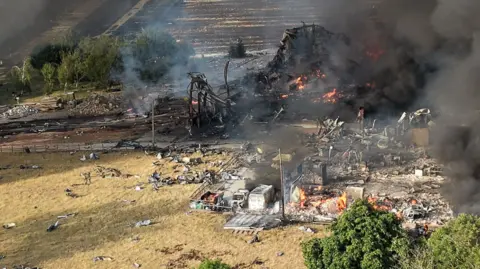
On 24 July 2026, more than 100 firefighters attended a major fire at Highlands Farm near Rettendon in Essex. The fire spread to a fertiliser store, triggering a blast that damaged nearby businesses and affected the surrounding area.
According to BBC Essex’s report of 30 September, Coral Passion owner Tony Brazao lost several hundred fish, shrimp and coral. He described the cost as well into six figures, while saying that insurer MSIG Europe had been unwilling to pay more than £15,000.
MSIG said it could not comment on an individual claim, but stated that concerns are considered carefully through its established claims and complaints processes, with the option of referring matters to the Financial Ombudsman Service.
This article is not a conclusion on the merits of that particular claim. The full policy, schedule, correspondence and evidence would need to be reviewed before anyone could reach that view. But the reported dispute raises important questions for businesses across Essex, Kent and London.
The difference between a serious loss and an insured loss
Most business owners understandably start from the same position after a disaster: something has happened, the business has suffered, and the insurance should respond.
That is often the right expectation, but insurance does not work only by measuring how bad the event felt or how much money has been lost. The claim is assessed against the precise wording of the policy.
The reported sticking point in the Coral Passion case appears to concern the loss of electricity. The supply had to be switched off so firefighters could work safely. The business says that the livestock died because the power was disconnected. The policy, as reported, appears to treat livestock loss caused by a deliberate power shutdown differently from loss caused directly by the fire or a fault at the substation.
That distinction may feel unfair to a business owner. From a claims perspective, however, the question becomes how the cause of loss is defined under the contract. Was the loss caused by the fire, by the explosion, by a substation failure, by the emergency services’ intervention, or by a deliberate shutdown? The answer can affect whether an exclusion applies.
This is where the quality of the policy wording matters. A headline such as “fire and business interruption included” tells only part of the story. The exclusions, definitions, conditions and extensions may be just as important.
Do not wait until a claim to read the exclusions
Before renewal, business owners should ask their broker to explain any exclusion relating to a deliberate act, forced shutdown, loss of utilities, interruption of electricity, contamination, temperature change or failure of services.
These clauses can be especially important for businesses that depend on continuous power or controlled conditions. That includes aquatics businesses, food producers, refrigeration operations, manufacturers, workshops, server rooms and some medical or specialist trades.
The wording may distinguish between an interruption caused by a fault, an interruption ordered by an authority, and an interruption carried out deliberately for safety reasons. Those may sound like variations of the same event to a client, but they can be treated differently within a policy.
I think this is one of the areas where a broker adds real value. Comparing premiums and policy summaries is not enough. The wording needs to be read line by line, with the actual way the business operates in mind.
Business interruption cover needs current figures
A business can have buildings and contents insurance in place and still face a major financial problem if its business interruption cover is too low.
The limit should reflect the current turnover, gross profit and fixed costs, but it also needs to reflect the realistic period required to get the business trading again. That may be much longer than the period a business owner initially imagines.
After a major fire or blast, the delay can involve investigations, site clearance, planning permissions, structural surveys, specialist machinery, supply-chain problems, replacement stock and access restrictions. A business may also need to operate from temporary premises while the original site is repaired.
Using last year’s figures is risky, particularly after periods of inflation and growth. A company that has increased its turnover, expanded its staff or taken on larger contracts may already be underinsured before an incident occurs.
The same applies to alternative accommodation or temporary premises cover. It is worth checking whether the policy will pay for a temporary unit, storage, relocation costs, additional rent, transport and the practical expenses of keeping staff and customers operating during the recovery.
Our website also covers common underinsurance mistakes in relation to general contractor liability insurance, because underinsurance is not limited to large property claims.
Name the stock, tools and equipment accurately
The schedule should reflect what the business actually owns and uses, not what it owned several years ago.
For one business, that might mean stock and livestock. For another, it could mean tools, plant, machinery, specialist equipment, computers, vehicles or materials held for customers. Each category may have different limits, valuation rules and exclusions.
Contractors and tradespeople working from yards, units and workshops should pay particular attention to equipment kept away from the main premises. Tools may be covered only while in a locked vehicle, or only up to a specified limit. Plant may need to be listed separately. Customer property may require a different form of cover.
Replacement costs have also risen sharply in many areas. A machine, vehicle, building component or specialist tool may cost considerably more to replace than it did at the last renewal. This creates a heightened risk of underinsurance even where the business has not changed significantly.
The schedule should use accurate values and descriptions. If a business owns unusual, high-value or temperature-sensitive stock, it should not rely on a generic “contents” description without confirming that the cover responds as intended.
The first 48 hours can shape the claim
The immediate priority after a fire or explosion is safety. No business owner should enter a damaged site until the fire service or other responsible authority has confirmed that access is safe.
Once access is permitted, the evidence gathered in the first 48 hours can be extremely important. The business should notify the insurer and broker promptly, preserve damaged items where it is safe and practical to do so, and take photographs or video of the damage without disturbing the scene unnecessarily.
A simple evidence pack should include photographs, stock records, purchase invoices, asset registers, recent accounts, utility bills, supplier details, customer orders, payroll information and records showing the normal level of trading. Keep copies of all correspondence and note when access was restricted, when the power was disconnected and when services were restored.
The loss adjuster will need access and cooperation, but the business should not feel that it has to quantify a complex claim alone. Where the loss is substantial, professional help with calculating the property, stock and business interruption elements can make a significant difference.

Evidence is particularly important where the dispute concerns causation. In a case involving power loss, for example, records of the fire service’s instructions, the timing of the shutdown, temperature readings, equipment alarms and the condition of stock may all become relevant.
Contractors need trade-specific wording
Specialist trade cover is not interchangeable. Construction contractor insurance and general contractor liability insurance may be written with different exclusions, conditions and limits depending on the work being carried out.
A contractor working on structural repairs will present a different risk from a shopfitting company, groundworker, roofer, demolition contractor or electrical business. The policy may need to address work at height, hot works, subcontractors, hired-in plant, contract works, temporary works, tools and damage to property being worked upon.
Liability limits also need to be considered alongside the contracts being accepted. A client may require a particular level of public liability, employers’ liability or products liability cover, but the policy still needs to match the actual activities and responsibilities of the contractor.
This is why a line-by-line review with someone who understands the construction and trades market is worthwhile. The cheapest premium may not be the cheapest outcome if an exclusion or low sub-limit becomes relevant after an incident.
What Essex firms should do now
The Rettendon blast affected 42 businesses, many of them small or family-run. Chelmsford City Council provided £281,000 of emergency funding and business support, including advice, workspaces and help with business rates. That support is valuable, but it does not replace a properly structured insurance programme.
Business owners across Essex, Kent and London should use their next renewal as an opportunity to check the deliberate act and forced shutdown exclusions, update turnover and business interruption figures, review rebuilding and replacement costs, and confirm that stock, livestock, tools, plant and equipment are correctly named and valued.
They should also check whether temporary premises, alternative accommodation and increased cost of working are covered at realistic levels.
The wider lesson is straightforward. A business insurance claim is judged by the policy wording and by the evidence supporting the loss. Good cover should not be built around a headline premium. It should be built around the way the business operates, the assets it depends on and the length of time it would realistically take to recover.
For a no-obligation review of your business insurance, contact Moyak Insurance Services today. We provide individual and business insurance advice across Essex, Kent and London, including support for growing businesses, contractors and specialist trades.