📞 01375 392 087  ·  ✉ info@moyakinsurance.co.uk

Mon–Fri: 9:30am – 5:30pm

Category: Blog

  • Why New Safety Laws Will Change the Way You Handle General Contractor Liability Insurance

    [HERO] Why New Safety Laws Will Change the Way You Handle General Contractor Liability Insurance

    I’ve been in the insurance business for a long time, and if there’s one thing I can tell you for certain here in 2026, it’s that the construction landscape is unrecognisable compared to five or six years ago. If you’re a general contractor, you’ve likely felt the shift. It’s not just that the materials are more expensive or that labor is harder to find; it’s that the very definition of “responsibility” has been rewritten by the UK government.

    The Building Safety Act 2022 was the starting gun, but the secondary legislation and the enforcement we are seeing today have fundamentally changed how you need to approach your General Contractor Liability Insurance. At Moyak Insurance Services, I’ve sat down with dozens of directors who are only just realizing that their old policies: the ones they’ve auto-renewed for years: simply don’t have the teeth to handle the current regulatory environment.


    In this post, I want to cut through the jargon and talk about why these safety laws mean you can’t treat your insurance as a “set it and forget it” expense anymore.

    The Building Safety Act: A New Era of Accountability

    When the Building Safety Act first landed, many in the industry thought it was just about high-rise cladding. I remember talking to contractors who said, “Michael, I don’t do 18-metre residential blocks, so this doesn’t touch me.” I had to tell them then, and I’m telling you now: that’s a dangerous assumption.

    The Act introduced a rigorous new regime that affects the entire lifecycle of a building. Whether you are involved in the design, the construction, or the refurbishment, the “Gateways” system ensures that safety is checked at every turn. If you’re the principal contractor, you are now legally a “Dutyholder.” This isn’t just a title; it’s a legal weight. You are responsible for ensuring that the people you hire are competent and that the work meets all functional requirements of the Building Regulations.

    This increase in statutory duty means that if something goes wrong, the trail of breadcrumbs leads straight to your door. Your General Contractor Liability Insurance needs to reflect that. It’s no longer just about a slip and trip on-site; it’s about long-term structural integrity and compliance failures that might not surface for years.

    Sketch of a building blueprint with a magnifying glass highlighting safety inspection checks.

    The 30-Year Shadow: Why Your Tail Just Got Longer

    One of the most significant changes: and arguably the one that keeps most directors up at night: is the extension of the limitation period under the Defective Premises Act. It used to be six years. Then it jumped to 15 years for new claims, and a staggering 30 years retrospectively for work completed before the Act was passed.

    Think about that for a second. You could be held liable today for a project your firm finished back in the mid-90s.

    From an insurance perspective, this is a nightmare. Most standard public liability policies are “claims-occurring” policies, but when you’re looking at decades of potential exposure, the “run-off” cover and the stability of your insurer become paramount. I often see contractors who think they are covered, but when we dig into the details, their policy limits are eroded by legal costs, or worse, there are exclusions for specific types of work that were perfectly legal 20 years ago but are now considered high-risk.

    Professional Indemnity vs. Public Liability: The Blurring Lines

    I’ve written about this before, but it’s worth repeating because the confusion is still out there. We often get asked, PI vs Public Liability: which is better for your construction contractor insurance?. In the past, the distinction was easy: Public Liability (PL) covered “doing” things (damage to property or people), and Professional Indemnity (PI) covered “thinking” things (advice and design).

    But today, with the Building Safety Act, those lines are a mess. If you’re a general contractor and you make a “design choice” on-site: perhaps substituting a material because of supply chain issues: you’ve stepped into the realm of design. If that material later fails to meet safety standards, your PL policy might walk away, saying it was a professional error. If you don’t have robust PI insurance as part of your General Contractor Liability Insurance package, you are essentially self-insuring a multi-million-pound risk.

    Going forward, I think every general contractor needs to treat PI with the same level of importance as their employer’s liability. It’s not an “add-on” anymore; it’s the core of your protection against the new safety regulations.

    Compass and hammer sketch representing the link between professional indemnity and public liability.

    The “Golden Thread” and Your Insurability

    You’ve probably heard the term “Golden Thread” of information. It’s the requirement to keep a digital record of how a building was designed, built, and maintained. For many, it feels like more red tape. But I see it differently. I see it as your best defense.

    When an insurer looks at your business today, they aren’t just looking at your turnover. They want to see your data management. Can you prove what was installed behind that wall five years ago? Do you have the digital signatures from the sub-contractors?

    Insurers are becoming incredibly selective. If you can’t demonstrate that you follow the Golden Thread principles, you’ll find your premiums skyrocketing, or you might find yourself unable to get cover at all. I’ve seen some great firms get rejected by top-tier insurers simply because their record-keeping was still stuck in the 20th century. High-quality documentation makes you a “better risk,” and in this market, being a better risk is the only way to keep your costs down.

    Managing Sub-Contractor Risk

    As a general contractor, you’re only as strong as your weakest subbie. The new laws make you more responsible for their actions than ever before. It used to be enough to just check they had a certificate of insurance. Now, you need to be sure their policy doesn’t have “height exclusions” or “cladding exclusions” that might kick the liability back to you if they mess up.

    In our ultimate guide to business insurance, we talk about the importance of checking the fine print. Going forward, I’d suggest you make it a standard part of your procurement to have a broker review your major sub-contractors’ policies. It might seem like overkill, but when a safety inspector is breathing down your neck, you’ll be glad you did it.

    Steel chain sketch with a highlighted orange link representing sub-contractor liability risk.

    Practical Steps to Protect Your Business

    So, what should you actually do? It’s easy to talk about laws, but you have a business to run. Here is my pragmatic advice for navigating this:

    1. Audit Your Existing Cover: Don’t wait for renewal. Ask your broker specifically how your policy handles the Building Safety Act’s extended liability periods.
    2. Invest in Digital: If you haven’t moved to a digital site management system that tracks the Golden Thread, do it now. It will pay for itself in lower insurance premiums within two years.
    3. Review Your Contracts: Ensure your contracts with clients and sub-contractors clearly define dutyholder roles as per the new regulations.
    4. Don’t Skimp on PI: Even if you think you don’t “do design,” the law might disagree. Ensure your Professional Indemnity is adequate for the scale of projects you handle.
    5. Talk to Specialists: General insurance brokers might not understand the nuances of the 2022 Act. Work with someone who understands the construction industry inside and out.

    Final Thoughts

    The days of cheap, “no-questions-asked” General Contractor Liability Insurance are gone. The UK government has made it clear that the “buck stops here” for contractors. While it feels like a burden, these laws are actually pushing the industry toward a higher standard of quality.

    I think the firms that embrace these changes: the ones that get their insurance right and their data sorted: are the ones that will still be standing in another 30 years. At Moyak Insurance Services, we’re here to help you make sense of it all. It’s a complex world, but you don’t have to navigate it alone.

    If you’re worried about whether your current setup is enough, or if you just want a second pair of eyes on your policy, reach out to us. We’ve helped everyone from small tradesmen to large-scale developers navigate these waters, and we can do the same for you.


    Note: This post is for informational purposes and does not constitute legal or financial advice. Always consult with a professional broker regarding your specific insurance needs.

  • PI Vs Public Liability: Which Is Better For Your Construction Contractor Insurance?

    [HERO] PI Vs Public Liability: Which Is Better For Your Construction Contractor Insurance?

    If you have spent any time in the UK construction industry, you know that the phrase “Are you covered?” is as common as a morning tea break. But when I sit down with contractors to look over their portfolios, I often see a recurring pattern. Most have their Public Liability (PL) sorted: it’s usually the first thing a site manager asks for before you’re allowed to unload your tools. However, when I mention Professional Indemnity (PI), I’m often met with a blank stare or a shrug.

    The common misconception is that if you aren’t an architect or a structural engineer, you don’t need PI. In reality, the line between “doing the work” and “designing the work” has become incredibly blurred in modern construction. I think this is where many businesses leave themselves wide open to massive financial risk.

    When people ask me which is better for their Construction Contractor Insurance: Public Liability or Professional Indemnity: my answer is almost always the same: it isn’t a competition. They are two different tools for two very different jobs.

    Understanding Public Liability: The Shield Against Physical Mishaps

    Public Liability is the bedrock of any construction-related insurance policy. In my experience, most contractors understand this one because the risks are so visible. If you drop a brick on a passerby’s car or a visitor trips over a stray cable on your site, that is a PL claim.

    Specifically, PL covers you against third-party claims for:

    • Bodily injury (to anyone who isn’t an employee).
    • Property damage.
    • Legal expenses arising from these claims.

    For many general tradesmen liability insurance needs, PL is the primary focus. It is designed to protect you from the “oops” moments that happen in the physical world. If your work causes immediate, tangible damage to someone else’s stuff or health, PL is what stands between you and a potentially business-ending payout.


    Sketch showing property damage at a construction site for public liability insurance.

    Professional Indemnity: The Protection for Your Expertise

    Now, this is where it gets a bit more nuanced. Professional Indemnity isn’t about physical accidents; it’s about the “brain work.” It covers you if a client suffers a financial loss because of your professional advice, design, or specifications.

    I’ve spoken to many contractors who say, “I don’t do design, I just build what’s on the plans.” But the reality is often different. If you suggest a change in materials to save the client money, or if you spot an error in the original plans and “fix” it on the fly, you are technically providing a design service.

    If those changes later lead to a structural failure or mean the building doesn’t meet regulations, the client won’t be suing you for “property damage” in the traditional sense; they will be suing you for professional negligence. That is a PI issue.

    In fact, PI is increasingly becoming a standard requirement for construction contractor insurance because of the rise in Design and Build (D&B) contracts. If you are the main contractor on a D&B project, the client holds you responsible for everything: including the errors made by the architects or engineers you’ve hired. Without your own PI policy, you are effectively self-insuring that risk.

    The Key Differences: Occurrence vs. Claims Made

    One of the most important things I want to highlight: and this is something that catches a lot of people out: is how these two policies actually trigger.

    Public Liability is usually an “occurrence-based” policy. This means that as long as you had the policy active on the day the accident happened, you are covered, even if the claim is made years later.

    Professional Indemnity, however, works on a “claims-made” basis. This is a bit of a sting in the tail. For a PI policy to cover you, it must be active at the time the claim is made, not just when the work was done. If you finish a project in 2024, cancel your PI in 2025, and get sued in 2026, you have no cover. This is why “run-off” cover is so vital in our industry, but it’s a detail that off-the-shelf insurance websites rarely explain properly.

    Timeline sketch showing claims-made triggers for contractor professional indemnity insurance.

    Why “Both” is Usually the Right Answer

    I can see why contractors try to choose one over the other to save on premiums. But the gap between them is where the most expensive lawsuits live.

    Consider a scenario where you are installing a specialized HVAC system.

    1. The PL Scenario: During installation, a pipe bursts and floods the building’s lower floor. Your Public Liability covers the damage to the carpets and the building structure.
    2. The PI Scenario: You install the system perfectly, but it turns out you specified a unit that is underpowered for the building’s size. The building is too hot to work in, and the client loses weeks of productivity while it’s replaced. There is no “damage” to the building, but there is a huge financial loss. Your PL won’t touch this, but a PI policy would.

    As you can see, you aren’t double-insuring; you are covering two completely different avenues of liability. For a more comprehensive look at how these fit into a wider strategy, I often recommend checking out the ultimate guide to business insurance London which goes into detail on the broader landscape for firms operating in the capital.

    The Moyak Approach: Why Individual Assessment Matters

    At Moyak Insurance Services, we don’t believe in the “one size fits all” approach that you see on price comparison sites. In fact, I think that approach is dangerous for construction firms. A groundworks contractor in Essex has a very different risk profile than a high-end interior fit-out firm in Mayfair.

    When we look at your Construction Contractor Insurance, we don’t just ask for your turnover. We want to know:

    • Do you have “rights of recourse” against your sub-consultants?
    • Are you working under JCT or NEC contracts that mandate specific PI limits?
    • Does your work involve “pollution or contamination” risks (which are often excluded from standard PL)?

    We take a personal interest because we know that at the end of the day, you aren’t just buying a piece of paper: you’re buying the survival of your business. I’ve seen too many good firms go under because they had “the wrong type” of insurance, even though they were paying high premiums.

    Minimalist sketch of blueprints and tools for bespoke construction contractor insurance assessment.

    Practical Steps for Contractors

    If you are looking at your renewals or starting a new project, I’d suggest these three steps:

    1. Check Your Contracts: Don’t just look at the insurance section. Look at the “Indemnity” and “Design” clauses. If you are responsible for any part of the specification, you almost certainly need PI.
    2. Audit Your Subbies: If you hire sub-contractors, make sure you check their insurance certificates. If they don’t have PI and they make a design error, the client is coming for you first.
    3. Talk to a Specialist: Don’t rely on a generic broker who handles shops and takeaways. Construction is high-risk and highly technical. You need someone who understands the difference between a “pure building contract” and “design and build.”

    Going forward, the regulatory environment in the UK (especially post-Grenfell and with the Building Safety Act) is only getting stricter. The definitions of “accountable persons” and professional responsibility are expanding. I think that in the next few years, PI will be just as mandatory as PL for almost everyone in the supply chain.

    Final Thoughts

    So, which is better? Neither. They are the two halves of a complete protection strategy. Public Liability protects your hands and your feet: the work you do on the ground. Professional Indemnity protects your head: the decisions and advice you provide.

    If you’re unsure where your current policy leaves you, or if you’ve recently taken on larger contracts that involve more “advice” than “labour,” let’s have a conversation. At Moyak, we prefer the personal touch because we know that every contractor’s “perfect” policy looks a little bit different.


  • 7 Mistakes You’re Making with General Contractor Liability Insurance (and How to Fix Them)

    [HERO] 7 Mistakes You're Making with General Contractor Liability Insurance (and How to Fix Them)

    Running a construction business in the UK, particularly in high-demand areas like London and Essex, is a balancing act of logistics, labour, and legislation. As a director or project lead, you’re likely focused on the physical progress of your sites: the concrete pours in Romford or the fit-outs in Canary Wharf. However, the administrative backbone of your business, specifically your General Contractor Liability Insurance, is often where the most significant risks hide.

    In my years working within the insurance brokerage space, I’ve seen that many contractors treat their liability policy like a “set and forget” utility. But a policy that worked for you three years ago might be completely inadequate for the projects you’re winning today. Mistakes in your coverage don’t just lead to higher premiums; they can lead to total claim denials that threaten the very existence of your company.


    Here are the seven most common mistakes I see general contractors making today and, more importantly, how you can fix them before they become a problem.

    1. Sticking to “Minimum” Limits in a High-Value Market

    Many contractors start out with a standard £1 million or £2 million Public Liability limit. While this might suffice for minor residential repairs in smaller towns, it is increasingly becoming a barrier to entry for larger contracts in London and the South East.

    I’ve spoken to many firms that missed out on tendering for local authority projects or major commercial developments because their liability limits didn’t meet the “Gold Standard” of £5 million or even £10 million. In a city like London, where property values are astronomical and the density of people is high, a single accident involving a crane or a major fire can easily exceed a £2 million limit.

    How to Fix It: Don’t wait for a tender document to tell you your insurance is insufficient. Review your current project pipeline. If you’re moving from residential extensions to commercial combined business insurance territory, speak to your broker about increasing your limits. Often, the jump from £2m to £5m is surprisingly affordable compared to the risk of being underinsured or losing a contract.

    2. Misclassifying Your Business Activities

    This is perhaps the most dangerous mistake of all. When you take out a policy, you declare your “Business Description.” If you describe yourself as a “General Builder” but 40% of your turnover actually comes from high-risk roofing work or basement excavations, you are on thin ice.

    Insurers calculate risk based on what you tell them you do. If a claim arises from an activity that isn’t listed on your policy: for example, if you’re working at heights above your policy’s limit or using heat on a project when your policy excludes it: the insurer may have grounds to void the claim entirely. I have seen contractors in Essex lose everything because they forgot to update their insurer when they pivoted from internal renovations to structural groundworks.

    How to Fix It: Be brutally honest and specific. If your scope of work has changed, your policy needs to change with it. At Moyak Insurance Services, we make it a point to drill down into the specifics of a contractor’s daily operations to ensure the description on the certificate matches the reality on the ground.

    Sketch of blueprints and magnifying glass illustrating the need for accurate contractor liability insurance descriptions.

    3. Assuming “Vicarious Liability” is Automatic for Subcontractors

    A common misconception among general contractors is that their policy automatically covers any damage or injury caused by their subcontractors. This isn’t strictly true. Most General Contractor Liability Insurance policies require that you ensure your subcontractors have their own adequate insurance in place.

    If your subcontractor causes a major incident and their insurance is found to be invalid or non-existent, the claimant will look to you: the main contractor: for compensation. This is known as “Vicarious Liability.” If you haven’t followed the policy conditions regarding subcontractor vetting, your own insurer might refuse to step in.

    How to Fix It: Implement a strict “No Insurance, No Entry” policy for every site. You should collect and verify the insurance certificates of every bona-fide subcontractor (BFSC) every year. Ensure their limits match yours and that their policy doesn’t have exclusions that conflict with the work they are doing for you.

    4. Overlooking the “Care, Custody, and Control” Exclusion

    Standard Public Liability insurance is designed to cover damage to third-party property. However, many policies contain an exclusion for property that is in your “Care, Custody, or Control.”

    Imagine you are renovating a high-end Victorian terrace in London. If you accidentally knock over a ladder and smash the client’s expensive chandelier, your standard liability policy might not pay out because that chandelier was technically in your “care” while you were working in that room. This gap in coverage catches out hundreds of contractors every year.

    How to Fix It: Look for “Contract Works” or “All Risks” extensions within your commercial combined business insurance package. These additions are designed to cover the work in progress and the property you are working on, filling the gap that standard Public Liability leaves behind.

    5. Failing to Disclose Material Changes Mid-Term

    Business is rarely static. You might start the year with five employees and end it with fifteen. Your turnover might double after winning a major contract in Essex. Many contractors wait until the annual renewal to report these changes, but that is a mistake.

    Insurance is a contract of “Utmost Good Faith.” If your business grows significantly or changes its risk profile mid-term and you don’t inform the insurer, you are effectively operating under a policy that no longer represents your business. In the event of a claim, an insurer could argue that had they known about the increased payroll or turnover, they would have charged a higher premium or applied different terms.

    How to Fix It: Treat your insurance broker as a business partner. Whenever you make a significant hire, purchase a new fleet of vehicles, or sign a contract that significantly boosts your turnover, send a quick update. Going forward, making this a habit ensures your protection scales alongside your success.

    Hand-drawn sequence showing construction business growth from tools to cranes for scaling liability insurance needs.

    6. Neglecting the Nuances of Employers’ Liability

    In the UK, Employers’ Liability (EL) is a legal requirement if you have even one employee. However, the mistake contractors make is in the definition of an “employee.” For insurance purposes, “Labour-Only Subcontractors” (LOSC) are often treated as employees.

    If you hire someone who uses your tools, works under your direct supervision, and doesn’t provide their own materials, they are likely an LOSC. If they get injured on your site in London and you haven’t declared them as part of your EL headcount, you are not only facing a massive financial liability but also potential legal action from the Health and Safety Executive (HSE).

    How to Fix It: Accurately split your payroll between bona-fide subcontractors and labour-only subcontractors when discussing your General Contractor Liability Insurance. It’s better to pay the correct premium now than to face a £2,500 fine per day for not having the right EL cover in place.

    7. Choosing Price Over Expertise

    I see it every day: a contractor goes onto a comparison site, finds the cheapest “General Tradesman” policy, and thinks they’re covered. But general tradesman policies are often “off-the-shelf” products that aren’t built for the complexities of a general contractor managing multiple sites, various trades, and high-value contracts.

    A specialist broker understands the local landscape. They know that a contractor working in Central London faces different risks: such as “Party Wall” issues or “Non-Negligent Liability” (6.5.1 insurance): than someone doing garden walls in a rural area. Choosing the cheapest policy often means you’re buying a policy full of exclusions that you won’t discover until it’s too late.

    How to Fix It: Work with a specialist like Moyak Insurance Services. We don’t just sell you a policy; we look at your contracts, your site locations, and your growth plans to build a bespoke insurance programme. Whether you need estate agent lettings insurance for a property portfolio or high-limit liability for a construction firm, expertise always pays for itself in the long run.

    The Practitioner’s Perspective

    I think the biggest issue in the industry right now is the “compliance gap.” Contractors are busier than ever, and insurance is often seen as a hurdle to jump over rather than a safety net to rely on. But if you’re working in the London or Essex construction market, the stakes are too high to leave things to chance.

    At Moyak, we’ve seen how a well-structured General Contractor Liability Insurance policy can be a competitive advantage. When you can present a comprehensive, professionally brokered insurance portfolio to a potential client, it speaks volumes about your professionalism and reliability.

    Moving Forward

    If any of these mistakes sound familiar, don’t panic: but don’t wait. The first step is a simple audit of your current documents. Check your business description, check your limits, and check your subcontractor requirements.

    If you’re unsure where you stand, reach out to us. We’ve helped countless contractors across the South East tighten up their coverage and often find that we can provide better protection for a similar cost simply by removing the errors and omissions that lead to “premium leakage.”

    Your business is built on solid foundations; make sure your insurance is too.


    Next Steps:


    • Review your current Public Liability limit against your largest upcoming contract.
    • Audit your subcontractor insurance certificates for the current year.
    • Schedule a consultation with a specialist broker to discuss your commercial combined business insurance needs.

  • Why the 2026 IR35 Rules Will Change the Way You Handle Construction Contractor Insurance

    [HERO] Why the 2026 IR35 Rules Will Change the Way You Handle Construction Contractor Insurance

    As we sit here in the spring of 2026, the landscape for the UK construction industry has shifted once again. For those of us who have been navigating the complexities of off-payroll working rules for years, the changes that came into effect this month aren’t just another layer of red tape: they represent a fundamental pivot in where the risk lies. If you are managing a growing construction firm or working as a high-level specialist contractor, the way you look at your Construction Contractor Insurance needs to change immediately.

    I have spent a lot of time recently talking to clients in the City and across the Home Counties about these updates. Whether you are seeking Business Insurance London or looking for a more tailored approach to Business Insurance Essex, the conversation always comes back to the same thing: who is holding the liability when HMRC comes knocking?


    The 2026 Shift: Responsibility Returns to the Contractor

    The headline change for April 2026 is one that caught many off guard. For a long time, the burden of determining IR35 status sat firmly with the “end-user” or the client, provided they weren’t a small business. However, new statutory thresholds have seen approximately 14,000 companies reclassified as “small.”

    What does this mean for the average construction project? It means that for a huge number of contracts, the responsibility for determining IR35 status has shifted away from the hiring company and straight back onto the individual contractor.

    I think this is a bit of a double-edged sword. On one hand, contractors regain control over their own status determinations. On the other, they are now the primary target for HMRC if that determination is found to be incorrect. In the construction sector: which HMRC has long flagged as a high-risk area due to the “supervision, direction, or control” nature of the work: this is a significant financial threat.

    Sketch of a construction contractor managing IR35 compliance responsibility for small businesses.

    Why Construction is Under the Microscope

    Construction has always been a unique beast when it comes to tax and employment status. Unlike a software developer who might work entirely remotely and autonomously, a construction contractor is often on-site, using the client’s heavy machinery, and following a strict project manager’s schedule.

    This creates a “grey area” that HMRC loves to explore. If you are a site manager or a specialist engineer working through a limited company, your daily reality often looks a lot like employment, even if your contract says otherwise. With the 2026 rules, if you’re working for one of those 14,000 newly reclassified small firms, you are the one who has to prove you are genuinely in business on your own account.

    I’ve seen how these investigations play out. They aren’t just about the tax you owe; they are about the legal fees, the time spent away from the site, and the massive stress of defending your professional reputation. This is where your insurance portfolio needs to step up.

    Adapting Your Construction Contractor Insurance

    If you haven’t reviewed your policy since the start of the year, you might be exposed. Standard General Contractor Liability Insurance is excellent for covering physical risks: accidents on site, damage to property, or injury to the public: but it rarely touches the sides of a tax investigation.

    Going forward, a robust insurance pack for a construction professional in 2026 needs to include:

    1. Professional Indemnity (PI) Insurance: This is often a requirement for winning tenders, but you need to ensure it includes “Fitness for Purpose” or specific contractual liability cover that matches the complexity of modern builds.
    2. Tax Investigation Cover: This is no longer an “optional extra.” It should cover the costs of professional representation during an IR35 inquiry.
    3. Legal Expenses Insurance: Specifically tailored to contract disputes and HMRC challenges.

    At Moyak Insurance Services, we take an individual approach to every client. We don’t believe in “off-the-shelf” policies because a contractor working on a residential development in Essex has a completely different risk profile than a firm handling commercial retrofitting in Central London. We care about every client, ensuring that your cover actually matches the reality of your day-to-day work.

    The “Small Company” Trap

    One of the biggest risks I see right now is the lack of communication between contractors and their clients regarding these new thresholds. A contractor might assume the client is still responsible for the Status Determination Statement (SDS), while the client: now technically a “small” business: assumes the contractor is handling it.

    If no determination is made, or if it’s made incorrectly, the financial penalties can be staggering. We are talking about back-dated National Insurance contributions, unpaid tax, and interest that can stretch back years. For a growing business, this is enough to end the company.

    Magnifying glass inspecting construction contractor status on blueprints for IR35 tax compliance.

    Practical Steps for Construction Firms in London and Essex

    If you are a larger firm hiring sub-contractors, or a specialist contractor yourself, here is how I suggest you handle the coming months:

    • Audit Your Client List: If you are a contractor, ask your clients for a formal statement on their size. Don’t guess. If they are now a “small company” under the 2026 rules, you need to initiate your own IR35 assessment.
    • Update Your Documentation: HMRC doesn’t just look at the contract; they look at the “hypothetical contract”: what actually happens on site. Ensure your working practices match an “outside IR35” status. Do you have the right of substitution? Do you provide your own equipment?
    • Seek Specialist Advice: Don’t rely on automated online tools. They are often too blunt for the nuances of the construction industry. I always recommend speaking to a broker who understands the local market, whether that’s the specific demands of Business Insurance Essex or the high-stakes environment of London construction.

    Why the Individual Approach Matters

    I’ve noticed a frustrating trend in the insurance industry where everything is moving toward automation. You put your details into a form, and a computer spits out a price. But a computer doesn’t understand the nuance of the 2026 IR35 shift. It doesn’t know that your “site supervision” is actually “consultancy” or that your “equipment” includes a £100,000 specialist plant.

    At Moyak, we prefer to have a conversation. By understanding the specifics of your projects, we can help tailor a Construction Contractor Insurance package that includes the necessary protections against HMRC’s new focus. Whether you are a large company managing dozens of subbies or a growing business making its mark, we treat your risk as if it were our own.

    Looking Ahead: The Future of Contracting

    The 2026 rules are likely just the beginning. The government is clearly moving toward a more rigid definition of employment. To survive and thrive in this environment, construction professionals must become as adept at risk management and compliance as they are at project delivery.

    The firms that will win the best contracts in London and the South East are those that can prove they are fully compliant. Having a comprehensive insurance policy isn’t just about protection; it’s a badge of professionalism that shows your clients you are a low-risk partner.

    Sketch of the London skyline with cranes, illustrating business insurance and IR35 compliance protection.

    Conclusion: Don’t Leave it to Chance

    The changes to IR35 in 2026 have effectively moved the goalposts. If you are operating in the construction sector, the “wait and see” approach is no longer viable. The risk has migrated, and your insurance must follow it.

    If you’re feeling unsure about how these changes affect your current cover, or if you’re looking for a brokerage that actually takes the time to understand your business, we’re here to help. From Business Insurance London to the growing hubs of Essex, we provide the expertise and the care you need to keep building with confidence.

    Next Steps:

    1. Check your client’s business size status for the 2026/27 tax year.
    2. Review your current Professional Indemnity and Liability policies.
    3. Contact Moyak Insurance Services for a full review of your contractor insurance needs.

    The industry is changing, but with the right protection, your business doesn’t have to be at risk. Let’s make sure you’re covered for the road ahead.

  • Why the 2025 Employment Rights Act Will Change the Way You Look at General Contractor Liability Insurance

    [HERO] Why the 2025 Employment Rights Act Will Change the Way You Look at General Contractor Liability Insurance

    If you’ve been operating in the London or Essex construction sector for any length of time, you’ll know that the goalposts don’t just move: they occasionally get dug up and replanted in a different stadium. That is exactly what has happened with the full rollout of the 2025 Employment Rights Act. While most of the initial chatter around this legislation focused on HR departments and “day one” rights, I’ve spent the last few months seeing the ripple effects hit the insurance markets.

    The reality is that this Act has fundamentally changed the risk profile of every firm holding General Contractor Liability Insurance. It isn’t just about how you pay your people or how you handle leave anymore. It’s about who “your people” actually are in the eyes of the law, and more importantly, who you are responsible for when something goes wrong on-site.

    The Blur Between Subbie and Staff

    For years, the construction industry in places like Romford, Chelmsford, and across Greater London has relied on a fluid ecosystem of bona-fide subcontractors and independent tradesmen. You hire them, they bring their own tools, they have their own insurance, and you move on. But the 2025 Act has pushed us closer to a “single status” of worker.

    The legal distinction between a self-employed contractor and an employee has become incredibly thin. Under the new rules, many individuals who were previously categorized as independent contractors are now being viewed as “workers” with a much broader range of protections. From an insurance perspective, this is a massive headache.

    I’ve noticed that insurers are becoming increasingly pedantic about how you classify your labor force. If the law says they are workers, but your insurance policy thinks they are independent subbies, you’re looking at a massive coverage gap. If a “contractor” is injured on-site and the courts deem them a worker under the 2025 Act, your Employers’ Liability (EL) needs to be rock solid. If you haven’t declared them correctly, you might find yourself self-insuring a very expensive claim.


    Sketch showing blurred distinction between staff and subbies under the 2025 Employment Rights Act.

    The Escalation of Vicarious Liability

    One of the most significant shifts we are seeing involves vicarious liability. In simple terms, this is the legal principle that makes an employer responsible for the actions (or negligence) of their employees. Historically, if a bona-fide subcontractor caused damage to a third-party property in Central London, their own Public Liability insurance would usually step up.

    However, the 2025 Employment Rights Act has expanded the “scope of employment.” Because the Act makes it easier for the courts to define a working relationship as an employment-like relationship, the “vicarious liability” umbrella has grown. I’m now seeing cases where the main contractor is being held directly responsible for the mistakes of a sub-contractor simply because the level of control and the nature of the contract now mirror an employment relationship under the new law.

    For those of us providing Business Insurance London, this means we have to look much closer at the “Rights of Recourse” in your policies. If your insurer can’t effectively pursue the sub-contractor’s insurance because the law views that sub-contractor as “yours,” your premiums are going to take the hit.

    Why London and Essex Firms Are Feeling the Pinch

    It’s no secret that the cost of doing business in the South East is higher than elsewhere, but the 2025 Act has added a specific layer of complexity to Business Insurance Essex. We have a high density of mid-sized contracting firms that rely heavily on flexible labor pools to manage fluctuating project demands.

    In London, where site conditions are often cramped and the risk of third-party damage is high, the stakes are even higher. I spoke with a director of a fit-out firm in Shoreditch last week who was shocked to find his renewal quote had jumped by 20%. The reason? His insurer had reassessed his “sub-contractor spend” in light of the 2025 Act, assuming that a larger portion of that labor now fell under his direct liability.

    Going forward, “business as usual” isn’t going to cut it. You can’t just tick the same boxes you did in 2023. The insurers are digging into the contracts you sign with your tradespeople to see if they align with the new Employment Rights standards. If your contracts look like employment contracts, your General Contractor Liability Insurance needs to reflect that.

    Contractor liability insurance umbrella shielding business owners from vicarious liability risk.

    The “Day One” Impact on Safety and Risk

    The Act introduced “day one” rights for workers, which includes immediate access to certain protections and a lower threshold for raising grievances. While this is primarily a labor issue, it translates into a safety risk.

    In my experience, when workers feel more secure in their status, they are more likely to report safety concerns: which is good. However, from a liability standpoint, it also means that any site accident is now scrutinized through the lens of these new rights. If an accident occurs and it’s found that the worker didn’t receive the “employee-level” safety training they were entitled to under the 2025 Act, the contractor’s negligence is much easier to prove in court.

    This isn’t just about Public Liability; it’s about the intersection of EL and Commercial Combined Business Insurance. You need to ensure that your risk management protocols have been updated to match the legal status of everyone on your payroll, regardless of whether you call them a “freelancer” or a “temp.”

    How to Fix Your Coverage Before It’s Too Late

    So, what do we actually do about this? I think the worst thing a business owner can do right now is assume their broker has it covered. Most standard policies haven’t automatically updated their definitions to match the 2025 Act. Here is how I suggest you approach the “fix”:

    1. Audit Your Labor Contracts: Sit down with your legal counsel or an HR specialist and determine how many of your regular subbies now qualify as “workers” under the 2025 Act. Don’t guess.
    2. Declare Your True Labor Split: When you talk to us at Moyak or your current broker, be honest about the level of control you have over your contractors. If you provide the tools, set the hours, and they only work for you, the insurer needs to know. It might increase the premium slightly now, but it’s a lot cheaper than a declined claim later.
    3. Check Your Vicarious Liability Clauses: Ensure your Public Liability policy specifically covers acts of all “workers” as defined by current legislation, not just “employees” as defined by old HMRC rules.
    4. Review Professional Indemnity: If you are involved in design and build, the 2025 Act can also affect your Professional Indemnity. If a “worker” makes a design error, the line of responsibility is much shorter than it used to be.

    Magnifying glass over documents with London skyline, illustrating business insurance audit in London.

    A Practical Conversation

    I know this sounds like a lot of “insurance-speak,” but at the end of the day, it’s about protecting your livelihood. Whether you are running a cleaning company with a few vans or a major construction firm in the heart of London, the law has changed the way you are viewed as an employer.

    We have spent a lot of time at Moyak Insurance Services looking at these specific legislative shifts. We don’t just want to sell you a policy; we want to make sure the policy actually works when you need it. The 2025 Employment Rights Act is a permanent change to the landscape. If your insurance is still living in 2023, you are exposed.

    If you’re worried about how these changes affect your current standing, or if your renewal is coming up and you’ve noticed a suspicious price hike, let’s have a chat. We specialize in navigating the complexities of Business Insurance London and Business Insurance Essex, and we can help you figure out exactly where you stand.

    Going forward, the contractors who thrive will be the ones who treat their insurance as a dynamic part of their business strategy, not just a certificate they keep in the glove box.

    Sketch of a worker walking safely above a net, representing tradesmen liability insurance protection.

    Next Steps for Contractors

    My recommendation is to perform a mid-term review of your General Tradesmen Liability Insurance or your broader contractor policy. Don’t wait for the renewal date. If your business model involves a lot of sub-contracted labor, the 2025 Employment Rights Act has already changed your risk profile.

    Check your “Bona-Fide Sub-Contractor” (BFSC) and “Labour Only Sub-Contractor” (LOSC) definitions in your policy wording. If those definitions don’t align with how the new Act classifies your team, you need an endorsement on your policy immediately.

    Feel free to reach out to us at Moyak. We’re here to help you make sense of the mess and ensure that your business remains as solid as the structures you build. You can find more information on our General Contractor Liability Insurance page or drop us a line for a more personal consultation. Keep building, but keep yourself covered.

  • 10 Reasons Your General Contractor Liability Insurance Isn’t Enough (And How to Fix It)

    [HERO] 10 Reasons Your General Contractor Liability Insurance Isn't Enough (And How to Fix It)

    In the construction world, we often talk about insurance as if it’s a “set it and forget it” box to tick. You get your General Contractor Liability Insurance, you hand the certificate to the project manager, and you get to work. But as we move through 2026, I’ve noticed a worrying trend. The gap between what a standard policy covers and the actual risks we see on-site in places like London and Essex is widening.

    I speak to contractors every week who believe they are “fully covered” because they have a public liability policy. The reality is that a standard policy is often just the bare minimum: the entry ticket to a site, but not necessarily the safety net that saves your business when things go sideways. From changing regulations like the Building Safety Act to the skyrocketing costs of materials, the old “standard” isn’t enough anymore.

    Here are 10 reasons why your current cover might be failing you, and more importantly, how you can fix it.


    1. The “Your Work” Exclusion

    This is the most common shock for contractors. Standard General Contractor Liability Insurance is designed to cover damage to other people’s property, not your own work. If you install a roof and it leaks, damaging the client’s expensive furniture, the insurance covers the furniture. But it won’t pay to fix the roof you installed poorly.

    The Fix: You need to look into Contractors Errors and Omissions (E&O) or specific “faulty workmanship” endorsements. I think it’s essential to clarify with your broker exactly where the “property damage” ends and “defective work” begins.

    2. Inadequate Limits for 2026 Projects

    Five years ago, a £1 million or £2 million limit was standard for many SMEs. But in today’s market, especially if you are looking for Business Insurance London, those limits are often laughed at. With the rising cost of litigation and property values in the South East, a single major incident can easily breeze past a £2 million cap.

    The Fix: Don’t just settle for what the client asks for. Evaluate the “worst-case scenario” for your specific project. Increasing your limit to £5 million or £10 million is often surprisingly affordable compared to the massive risk of being underinsured.

    Small umbrella against London's skyline showing the need for adequate Business Insurance London limits.

    3. Professional Liability Gaps (Design-Build Risks)

    Are you giving advice? Are you suggesting changes to a blueprint or choosing specific materials for their performance? If so, you are moving into the realm of professional services. Standard liability policies explicitly exclude “professional acts.” If a design choice you made leads to a structural issue, your general liability policy will likely walk away.

    The Fix: If you have any hand in the design process, you need Professional Indemnity (PI) Insurance. We see this often in Construction Contractor Insurance where the line between “contracting” and “consulting” is blurred.

    4. The Subcontractor Trap

    I see this happen all the time: a general contractor hires a sub, assuming the sub has their own insurance. But what happens if the sub’s policy has lapsed? Or if their limits are too low? In the eyes of the law, you: the general contractor: are often vicariously liable for their mistakes. If your policy has a “Subcontractor Exclusion” or strict warranty requirements you haven’t met, you’re on the hook.
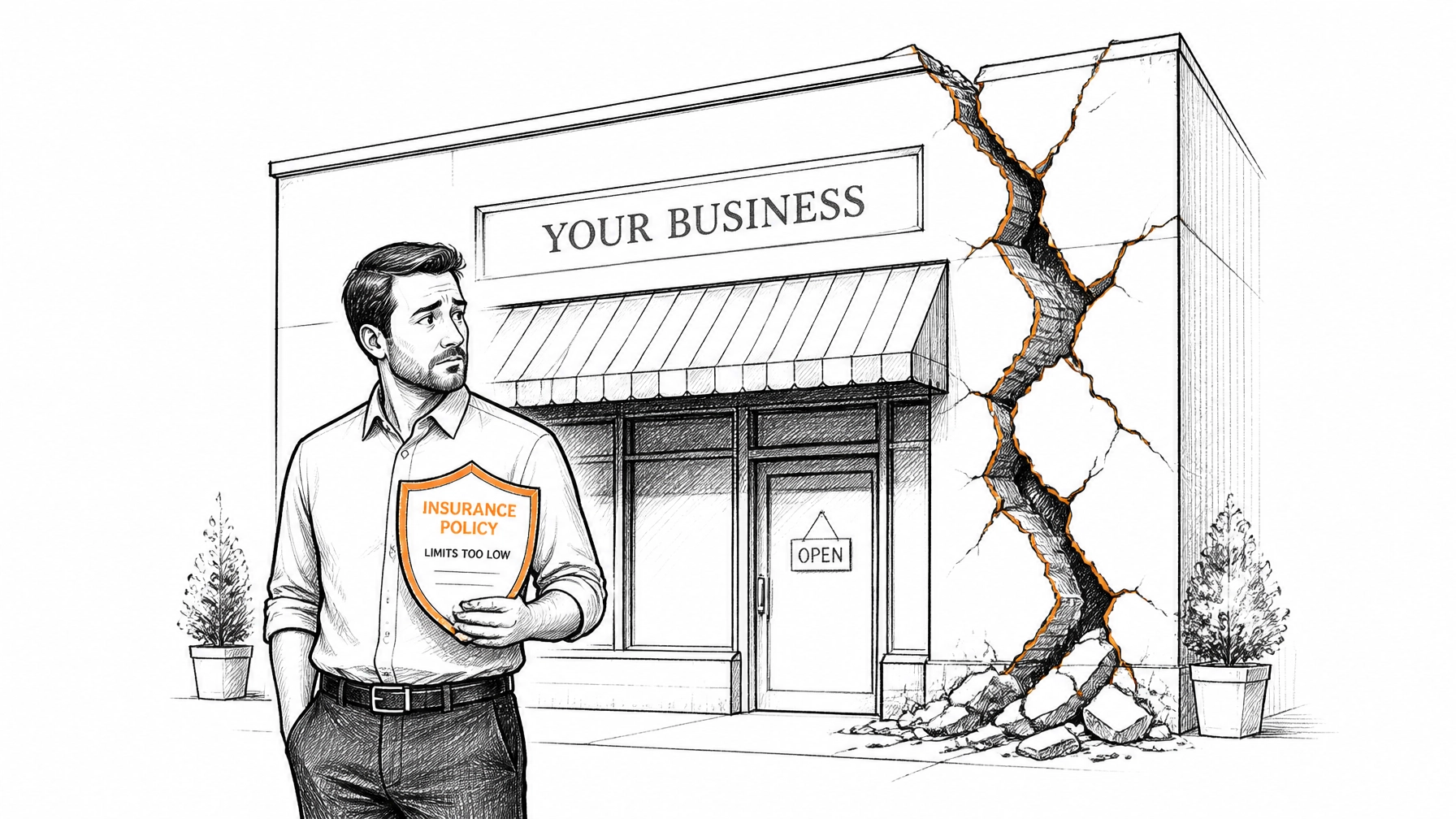
    The Fix: Implement a strict “COI (Certificate of Insurance) Tracking” system. Ensure your subcontractors name you as an Additional Insured and that their limits match yours. Better yet, speak to us at Moyak Insurance Services about a policy that specifically covers vicarious liability.

    5. Pollution and Environmental Risks

    Most contractors think “pollution” is only for chemical plants. But in construction, pollution can be as simple as silt runoff into a local drain, hitting a gas line, or disturbing old asbestos during a renovation in an Essex high-street shop. Standard policies usually have a total pollution exclusion.

    The Fix: Ask for a Contractors Pollution Liability (CPL) policy or endorsement. It covers the cleanup costs and third-party claims that a standard policy won’t touch.

    Leaking pipe sketch highlighting environmental risks and General Contractor Liability Insurance gaps.

    6. Completed Operations Timeframes

    A standard policy covers you while you are on the job. But what about three years from now? Latent defects: issues that take years to manifest, like slow water leaks or structural settling: can lead to massive claims long after you’ve handed over the keys. If you’ve switched insurers or your policy didn’t have a “run-off” or “completed operations” extension, you could be exposed.

    The Fix: Check your policy for Completed Operations coverage. Ensure the “Products-Completed Operations” limit is separate from your general aggregate limit so one claim doesn’t wipe out your entire bucket of protection.

    7. Cyber Risks in a Digital Job Site

    It’s 2026. You’re likely using BIM (Building Information Modeling), digital project management tools, and online banking for six-figure supplier payments. If your system is hacked or you’re hit with ransomware, your general liability won’t cover the lost data, the business interruption, or the forensic costs to get your business back online.

    The Fix: Cyber Insurance is no longer optional for contractors. It’s a vital part of a modern Business Insurance Essex strategy.

    8. Tools and Equipment (The “Inland Marine” Gap)

    Your general liability covers the damage your tools do to others, but it doesn’t cover the tools themselves if they are stolen or damaged in a fire. Given the high cost of specialized plant and machinery today, replacing a stolen fleet out of pocket can sink a small firm.

    The Fix: Ensure you have an Inland Marine (or Tools and Equipment) floater. This covers your gear wherever it goes: in your van, on the site, or in the warehouse.

    Secured excavator and tools illustrating Inland Marine coverage for Construction Contractor Insurance.

    9. Employment Practices Liability

    The construction industry is facing tighter labor markets and stricter regulations. Claims regarding wrongful termination, discrimination, or even “hostile work environment” are on the rise. These are “personal injury” claims that fall outside the scope of “bodily injury” covered by standard liability.

    The Fix: Look into Employment Practices Liability Insurance (EPLI). It protects the business against the costs of defending against claims from current, former, or even prospective employees.

    10. The Underinsurance Trap (Inflation)

    Inflation has been a roller coaster. If your policy was written based on 2023 values, it is likely out of date. If a site burns down and the cost to rebuild is now 30% higher due to material and labor costs, you might find yourself hitting your policy cap before the job is even half-finished.

    The Fix: Conduct an annual review of your “Sum Insured” values. Don’t just renew the same policy; adjust the numbers to reflect the current reality of the London and Essex construction markets.

    Summary: Taking Control of Your Risk

    I believe the biggest mistake a contractor can make is assuming that “Insurance” is a single product. It’s a strategy. A standard liability policy is a great foundation, but it’s the endorsements and the “wraparound” covers: like E&O, Pollution, and Cyber: that actually protect your balance sheet.

    Going forward, I recommend a three-step approach:

    1. Audit your contracts: Ensure your insurance actually matches the indemnification clauses you are signing.
    2. Review your subs: Don’t take their word for it; verify their coverage.
    3. Talk to an expert: At Moyak Insurance Services, we don’t just sell policies; we help you understand the specific gaps in your niche.

    Whether you are looking for General Tradesmen Liability Insurance or complex commercial cover, it’s about fixing the holes before the rain starts.

    Next Steps: If you haven’t reviewed your policy in the last 12 months, now is the time. Let’s sit down and make sure your 2026 projects are actually protected.


  • Looking For Construction Contractor Insurance? 5 Things You Need to Know Before the October 2026 Building Safety Levy

    [HERO] Looking For Construction Contractor Insurance? 5 Things You Need to Know Before the October 2026 Building Safety Levy

    With April 2026 already underway, the construction industry is staring down a significant deadline. The Building Safety Levy is set to go live on October 1st, 2026, and if you are currently looking for construction contractor insurance, this isn’t just a “developer problem” you can ignore. I have been watching the discussions around this for months, and it is clear that many contractors still feel they are insulated from these changes.

    In my view, the levy represents one of the most substantial shifts in the financial landscape of UK construction since the original Building Safety Act. While the levy is technically a charge on developers for new residential buildings, the shockwaves will hit every part of the supply chain. From the way contracts are priced to the level of professional indemnity cover you need, the landscape is shifting.


    Whether you are seeking Business Insurance London for high-rise projects or Business Insurance Essex for local residential developments, here are the five essential things you need to know to stay protected and profitable.

    1. The Levy “Trickle-Down” Effect on Your Margins

    The most immediate thing to understand is that while you might not be the one writing the cheque to the government, you will feel the weight of it. The Building Safety Levy is designed to raise funds for cladding remediation, and developers will be charged at the point of seeking building control approval.

    I think it is inevitable that developers will look to recoup these costs elsewhere. Going forward, we are likely to see even tighter margins on tenders. If a developer is paying a significant levy on a project, they will be looking for contractors who can demonstrate extreme efficiency. From an insurance perspective, this means your Construction Contractor Insurance needs to be rock solid. If a project budget is already squeezed by the levy, there is zero room for uninsured losses or disputes over who is responsible for a delay.

    I’ve seen many cases where contractors assume their standard liability is enough, but in a post-levy world, the financial stakes of every project are higher. You should be reviewing your Commercial Combined Business Insurance to ensure it covers the full scope of your contractual obligations as budgets tighten across the board.

    Sketch of a crane lowering a block, illustrating budget pressure for construction contractor insurance.

    2. Compliance Mistakes Are About to Get Much More Expensive

    One of the biggest takeaways from the recent industry research is that the levy fundamentally changes the price of failure. Before the levy, a compliance error was a headache; after October 2026, it becomes a financial disaster.

    The new regulatory framework means that rework and compliance breaches will be monitored more strictly than ever. If a project is delayed because of a safety non-compliance, and that delay interferes with the levy payment schedule or the building control approval process, the developer is going to look for someone to hold accountable.

    I believe that Professional Indemnity (PI) insurance is going to be the “make or break” policy for contractors this year. If your design work or professional advice leads to a compliance failure that triggers additional costs or levy complications, you need to be sure your policy hasn’t excluded these specific safety-related risks. I’ve often said that standard liability isn’t enough for specialist businesses, and this is doubly true for contractors facing the 2026 levy.

    3. Rebuild Values Must Be Updated Immediately

    This is a point I keep hammering home because it is so easy to miss. The Building Safety Levy is part of a broader trend of rising construction costs. As the levy is implemented, the overall cost of delivering residential units in the UK will increase.

    If you are insuring a project or your own business premises, you must ensure that your “Sum Insured” reflects 2026 reality, not 2022 prices. If you have an incident on-site and your insurance is based on outdated rebuild costs, you will find yourself “underinsured.” This means the insurer might only pay out a proportion of the claim, leaving you to cover the rest.

    I recently wrote a guide on how construction insurance premiums are calculated in 2026, and one of the biggest factors is the accuracy of your valuations. With the levy adding another layer of cost to the industry, making sure your policy reflects the true cost of materials, labour, and regulatory compliance is essential.

    Magnifying glass over blueprints highlighting compliance details for construction contractor insurance.

    4. Understanding Exemptions to Protect Your Pipeline

    Not every project will be subject to the levy, and knowing the difference is key to how you risk-manage your business. For instance, developments of 10 units or less are currently expected to be exempt, as is affordable housing and certain non-residential buildings.

    However, the definitions are strict. I’ve seen contractors get caught out because they assumed a mixed-use project in London would be exempt, only to find the residential portion triggered the levy. If you are working on smaller projects in areas like Essex, you might be safe from the levy itself, but you will still be competing in a market where the larger players are shifting their strategies.

    When you are looking for Business Insurance Essex, your broker should be asking you about the type of projects you are taking on. If you are pivoting from larger levy-heavy developments to smaller exempt ones, your insurance risk profile changes. You don’t want to be paying for high-risk cover if your business model has shifted to lower-risk, exempt residential work.

    5. Competence is Now a Rankable Risk Factor

    Going forward, “competence” is no longer a buzzword; it is a legal requirement. Under the Building Safety Act and the secondary legislation surrounding the levy, the competence of the people on-site is a primary concern for building control.

    From an insurance perspective, I can see that underwriters are becoming much more interested in who is doing the work. In the past, they might have just looked at your turnover and your claims history. Now, they want to see evidence of training and adherence to updated safety standards, like the BS 9792:2025 fire risk assessments.

    Investing in staff training for site managers and supervisors isn’t just about safety; it’s about making your business “insurable” at a reasonable price. Contractors who can prove they have a competent workforce are going to secure better rates for their Construction Contractor Insurance. I think we are moving toward a two-tier insurance market: one for firms that can prove competence and one for those who can’t. The latter will find their premiums skyrocketing as we get closer to October.

    Hard hat on professional portfolios symbolizing competence for construction contractor insurance risk.

    Practical Next Steps for Your Business

    The arrival of the Building Safety Levy in October 2026 is a milestone, but the preparation needs to happen now. Here is what I suggest you do before the summer hits:

    • Audit Your PI Insurance: Ensure there are no “silent” exclusions regarding the Building Safety Act or design defects that could lead to levy-related disputes.
    • Review Your Tenders: Factor in the potential for “cost-shifting” from developers who are facing the levy. Ensure your contracts have clear clauses regarding delays caused by building control approvals.
    • Check Your Valuations: Talk to your broker at Moyak Insurance Services to ensure your rebuild costs and project values are accurate for 2026.
    • Document Competence: Start a central file of all staff certifications and safety training. You will need this when it’s time to renew your Business Insurance London or Essex policies.

    The October 2026 deadline might feel far away, but in the construction world, six months is the blink of an eye. By getting your insurance and compliance in order now, you’ll be in a much stronger position to navigate the changes without taking a hit to your bottom line.

    If you have questions about how these changes affect your specific policy, don’t hesitate to reach out. We’re here to help you make sense of the jargon and keep your business moving forward.


  • How Construction Insurance Premiums are Calculated in 2026: A Contractor’s Guide

    [HERO] How Construction Insurance Premiums are Calculated in 2026: A Contractor's Guide

    Alias: how-construction-insurance-premiums-are-calculated-2026-contractors-guide
    Category: Blog
    Scheduled Date: Thursday, 16 April 2026, 6:00 PM

    For any contractor working across Essex or London today, looking at an insurance renewal quote can sometimes feel like trying to read a blueprint in the dark. You see a number, you see it’s likely higher than last year, and you wonder what exactly triggered the increase. In our previous discussion, we touched on the pitfalls to avoid and how to start lowering your costs, but to truly master your business overheads, you need to understand the “why” behind the premium.

    In 2026, the landscape of Construction Contractor Insurance has become more data-driven than ever. Insurers are no longer just looking at your annual turnover and calling it a day. They are peeling back the layers of your operations, from the specific materials you use on a site in Chelmsford to the safety protocols your team follows in Central London. Understanding these calculation factors isn’t just an academic exercise; it’s a competitive advantage. If you know how the math works, you can influence the variables.


    The Foundation: Replacement Cost Valuations (RCV)

    The most significant shift we’ve seen in 2026 is the laser focus on Replacement Cost Valuations. When an insurer calculates a premium for General Contractor Liability Insurance, they aren’t just looking at the price you’re charging the client. They are looking at what it would cost them to rebuild that project from scratch today if a total loss occurred.

    This includes everything: current market rates for timber and steel, specialist labor costs, equipment hire, and even the architectural fees required to redesign a failed structure. Over the last couple of years, we’ve seen these “soft costs” and material prices fluctuate wildly. If your coverage limits haven’t been updated to reflect the 2026 reality of rebuild costs, you aren’t just underinsured, you’re likely seeing a premium spike as the insurer “corrects” for that risk at the last minute.

    Sketch of a building frame and calipers representing accurate construction insurance rebuild cost valuations.

    Material Inflation and the Labor Crisis

    It’s no secret that the UK construction industry has faced a double-edged sword of material shortages and a shrinking pool of skilled tradespeople. From an insurance perspective, this creates a higher “severity potential.”

    When materials are expensive, every claim costs the insurer more. When labor is scarce, projects take longer. A project that sits open for twelve months instead of eight is a project that is exposed to weather, theft, and liability risks for four additional months. Insurers in 2026 are adding a “duration loading” to premiums for projects that exceed certain timeframes, simply because the window for something to go wrong is wider.

    Furthermore, we’ve seen that the quality of labor affects the rate. If you are a general contractor in London using a high percentage of bona-fide subcontractors, the insurer will look closely at their insurance as well. If your subcontractors aren’t adequately covered, that risk rolls up to you, and your premium will reflect that “unseen” exposure.

    Why Your Location in Essex or London Matters

    In the world of Business Insurance London, geography is a massive pricing factor. Working in the City or the West End brings a set of risks that you simply don’t find in the quieter parts of the Home Counties.

    1. Third-Party Exposure: In London, the proximity of neighboring buildings is the primary concern. If you’re working on a basement excavation in a tight London terrace, the “Third Party Property Damage” risk is astronomical compared to a detached new-build in Essex.
    2. Access and Logistics: Higher premiums in urban centers also account for the difficulty of emergency services reaching a site or the increased likelihood of opportunistic theft in high-traffic areas.
    3. Local Regulation: Specific boroughs have different requirements for hoarding, scaffolding, and environmental protections.

    When seeking Business Insurance Essex, you might find slightly more favorable rates for similar work, but insurers are now using GPS data and historical claim maps to pinpoint “hotspots” for tool theft or transit claims. If your yard is in an area with a high crime rate, your “tools in transit” or “plant” cover will be priced accordingly.

    The Specific Risk Profile: Your Trade Tier

    Not all contractors are created equal in the eyes of an underwriter. In 2026, the industry has clearly defined “Risk Tiers.”

    • Low Risk: Interior fit-outs, painting, decorating, and light landscaping.
    • Medium Risk: General building, plumbing, and electrical (excluding high-voltage or complex industrial work).
    • High Risk: Roofing, scaffolding, demolition, and anything involving “heat work” (torches, welding).

    If you are a general contractor, your premium is often a “blended rate” based on the highest-risk activity you perform. I’ve seen many businesses pay far too much because they are classified as “Roofers” when roofing only makes up 5% of their annual turnover. Ensuring your business description is accurate is one of the easiest ways to prevent premium inflation. You can learn more about how we categorise these on our General Tradesmen Liability Insurance page.

    Risk tier illustration for general contractor liability insurance showing low to high-risk trades.

    Safety Tech and Data: The 2026 Advantage

    One of the most positive developments in 2026 is that insurers are finally rewarding contractors who embrace technology. We are seeing premium discounts for firms that use:

    • IoT Site Monitoring: Sensors that detect water leaks or smoke during out-of-hours periods.
    • Telematics: For those with fleets, showing safe driving data can significantly lower Auto Liability within a Commercial Combined Business Insurance policy.
    • Digital Safety Audits: Moving away from paper trails to real-time safety reporting apps.

    If I can show an underwriter that a contractor has a 100% compliance rate on their digital site inductions, I can usually negotiate a much better rate than a firm that says, “Yeah, we take safety seriously,” but has no data to prove it.

    Practical Breakdown: Predicted Premium Shifts for 2026

    Based on the current market data we are seeing this April, here is what the average UK contractor should expect for their upcoming renewals:


    Well-run businesses with a focus on safety and accurate valuations are seeing single-digit increases or even flat renewals. Those with a history of “nuisance claims” or outdated safety protocols are unfortunately seeing much sharper climbs.

    Safety checklist and trend graph for business insurance London showing stable construction premium renewals.

    Managing Your Deductibles and Limits

    Finally, the math of your premium is heavily influenced by how much risk you are willing to keep. In a “hard market” where prices are rising, many contractors are choosing to increase their deductibles (the amount you pay toward a claim).

    I often tell my clients: “Insurance should be for the house fire, not the broken window.” By taking a higher voluntary excess, you demonstrate to the insurer that you have “skin in the game” and aren’t going to claim for every minor scrape. This can significantly reduce the base premium.

    However, you must balance this with your cash flow. There is no point in saving £500 on a premium if a £2,500 excess would bankrupt your business during a quiet month.

    Moving Forward: Your 2026 Strategy

    The calculation of Construction Contractor Insurance isn’t a dark art, but it is complex. Going forward, the most successful contractors will be those who treat insurance as a strategic financial pillar rather than a grudge purchase.

    At Moyak Insurance Services, we believe in transparency. We want you to understand why the numbers are what they are so you can take active steps to change them. Whether you are looking for General Contractor Liability Insurance or comprehensive cover for a large-scale development, the key is early engagement.

    Don’t wait until seven days before your renewal to start this conversation. Start it now. Review your valuations, check your subcontractor agreements, and ensure your safety data is ready to be presented.

    If you’re concerned about your current rates or feel your business hasn’t been properly “sold” to the underwriters, contact us today. We live and breathe the Essex and London construction markets, and we’re here to ensure the math finally works in your favor.

  • How to Avoid the Biggest Construction Contractor Insurance Pitfalls (and Lower Your Premium)

    [HERO] How to Avoid the Biggest Construction Contractor Insurance Pitfalls (and Lower Your Premium)

    In the construction world, we often talk about the “foundation.” If the footings are off by even an inch, the rest of the build is compromised. I see the exact same principle applied to Construction Contractor Insurance. Far too often, contractors view their insurance as a “tick-box” exercise: something they need just to get onto a site or satisfy a local authority. But if that foundation is shaky, a single claim can topple years of hard work.

    At Moyak Insurance Services, we take an individual approach to every client. I’ve seen firsthand how a one-size-fits-all policy fails when a real-world disaster strikes. The industry is changing, and the risks are becoming more complex. Whether you are managing a residential renovation or a major commercial build in the heart of the city, understanding the pitfalls of your coverage is the only way to protect your bottom line.


    1. The “Minimum Requirements” Trap

    One of the most common mistakes I see is contractors choosing their coverage limits based solely on what the contract requires. If a client asks for £5 million in public liability, many contractors will buy exactly that and nothing more.

    But here is the problem: the contract requirement is often a generalized figure. It doesn’t necessarily reflect the actual risk of the specific project. If you are working on a high-density site in London, for instance, the potential for third-party damage or business interruption for surrounding shops could far exceed that “standard” £5 million limit. In fact, we often discuss why local knowledge is your best defense when assessing these risks.

    The better approach is to base your limits on the “total completed value” of the project. This includes not just the materials and labour, but also the “soft costs”: things like interest on loans, architectural fees, and the potential costs of a delay. When you only cover the contract price, you’re leaving yourself exposed to the administrative and financial fallout of a major claim.

    Sketch of a construction crane lifting a block, representing high-rise project risks and insurance coverage needs.

    2. Neglecting the “Additional Insured” Endorsement

    I’ve had many conversations with general contractors who believe that simply seeing a Certificate of Insurance (COI) from a subcontractor is enough. It isn’t.

    If a subcontractor’s work leads to a claim, and you aren’t properly named as an “Additional Insured” on their policy, their insurer might only cover the subcontractor, leaving you to fight the legal battle for your own liability. Furthermore, you need to ensure that the coverage extends to “completed operations.” Most construction claims don’t happen while the crew is on-site; they happen months or even years later when a leak develops or a structural issue arises.

    If your subcontractor’s insurance only covers “ongoing operations,” you might find yourself holding the bag for their mistakes long after they’ve moved on to the next job. We always tell our clients at Moyak that caring about every client means helping them look at the fine print of their subcontractor agreements. It’s not just about your General Contractor Liability Insurance; it’s about the entire ecosystem of coverage on your site.

    3. The Builder’s Risk Timing Gap

    Builder’s Risk (or Course of Construction) insurance is a vital part of Construction Contractor Insurance, but the timing of when it starts and ends is a frequent pitfall.

    I recently read about a case where a contractor had expensive roof trusses delivered to a site on a Friday afternoon. A massive storm rolled through over the weekend, destroying the materials. Because the policy was set to trigger when “construction begins” (defined in that specific policy as the actual assembly of the frame), the insurer denied the claim for the stored materials.

    You need to ensure your policy triggers the moment materials arrive on-site or even while they are in transit. Conversely, many policies “cease” once the building is occupied or put to its intended use. If you have a delay in the final handover but the client starts moving furniture in, your coverage might vanish without you realizing it.

    Minimalist sketch of a handshake and legal document highlighting subcontractor insurance agreement requirements.

    4. Misclassification of Workers

    This is a pitfall that doesn’t just affect your coverage: it can lead to massive financial penalties during an audit. There is often a grey area between a “bona-fide subcontractor” and a “labour-only subcontractor.”

    If you tell your insurer you use bona-fide subs (who carry their own insurance), but you are actually providing the tools, supervising their every move, and paying them an hourly rate, the insurer will likely reclassify them as employees. This means your General Tradesmen Liability Insurance premiums will skyrocket at the end of the year when the audit happens. Worse, if a worker is injured and is found to be misclassified, your Employers’ Liability claim could be complicated or even rejected if the insurer feels you misrepresented the risk.

    5. Overlooking Exclusions: The “Faulty Workmanship” Problem

    Most General Liability policies are designed to cover “resultant damage,” not the cost to fix the mistake itself.

    If a plumber installs a pipe incorrectly and it bursts, the insurance will usually pay for the ruined carpets and the warped floorboards (the resultant damage). However, it often won’t pay for the plumber to come back and fix the actual pipe (the faulty workmanship). For many contractors, the cost of the “fix” can be just as devastating as the damage itself.

    To avoid this pitfall, I recommend looking into Professional Liability or Contractors’ Errors and Omissions (E&O) coverage. This is especially important if you provide any design-build services or even informal consulting. Many contractors think “I’m not an architect,” but if you suggest a change in material or a specific layout that later fails, you are effectively acting in a professional capacity.

    Architectural blueprint sketch identifying a point of failure to illustrate construction contractor liability risks.

    How to Lower Your Insurance Premium

    While it might feel like adding these coverages will only drive your costs up, the reality is that a well-managed risk profile actually lowers your premiums over time. Here is how you can reduce what you pay for Construction Contractor Insurance without sacrificing protection:

    Maintain a Strong Safety Record

    Insurers look at your “Loss Run Reports” for the last three to five years. A history of small, frequent claims is often a bigger red flag than one large, freak accident. It suggests a lack of oversight. By implementing a rigorous health and safety protocol and documenting it, you can negotiate better rates.

    Accurate Payroll and Turnover Projections

    Don’t guess. If you over-project your turnover or payroll, you are essentially giving the insurer an interest-free loan until your year-end audit. If you under-project, you’ll be hit with a massive bill later. Keeping your broker updated on your actual figures quarterly can help smooth out these costs.

    Use a Specialized Broker

    A generalist broker might not understand the nuances of Commercial Combined Business Insurance for the construction sector. At Moyak, our individual approach means we look for specific “carve-outs” and endorsements that fit your trade. We know which insurers are currently “hungry” for construction risk and who has the best appetite for specific niches, like Cleaning Company Business Insurance within a construction site context.

    Review Your Deductibles

    I often suggest that contractors who have a strong cash flow consider increasing their voluntary excess (deductible). If you can afford to pay the first £1,000 or £2,500 of a claim yourself, your annual premium will drop significantly. It shows the insurer that you have “skin in the game” and are committed to risk management.

    A construction hard hat on coins representing site safety and ways to lower contractor insurance premiums.

    The Moyak Individual Approach

    We believe that every contractor deserves a policy as solid as the structures they build. We don’t just sell you a policy; we partner with you to identify where your specific project might be vulnerable. From the initial quote to the final audit, we are here to ensure that your insurance works for you, not the other way around.

    If you’re concerned that your current coverage has gaps, or if you simply feel you’re paying too much for a policy that doesn’t fit, it’s time for a professional review. Construction is a high-stakes industry: don’t let a misunderstood exclusion or a timing gap be the reason your business suffers.

    To explore how we can tailor a package for your specific needs, visit our Main Page or contact us directly to discuss your project.


  • Are You Making These Common General Contractor Liability Insurance Mistakes with Subcontractors?

    [HERO] Are You Making These Common General Contractor Liability Insurance Mistakes with Subcontractors?

    If you are running a construction firm in the UK, you know that your subcontractors are the lifeblood of your projects. Whether you are managing a residential renovation in Essex or a large-scale commercial build in Central London, you can’t be everywhere at once. You rely on electricians, plumbers, and bricklayers to get the job done. But from an insurance perspective, every subcontractor you bring onto a site represents a potential “blind spot” in your coverage.

    I’ve spent a lot of time talking to directors and project managers who are under the impression that their primary policy is a safety net for everyone under their umbrella. While it’s true that a solid General Contractor Liability Insurance policy is essential, there are several common mistakes I see contractors making when it comes to their “subbies.” These mistakes don’t just lead to higher premiums; they can lead to total claim denials that could bankrupt a firm.

    At Moyak Insurance Services, we see the fallout when these details are missed. Let’s walk through the most common pitfalls so you can make sure your business stays protected.


    The Myth of Automatic Coverage

    One of the most dangerous assumptions a general contractor can make is thinking that their subcontractors are automatically covered under their own Construction Contractor Insurance.

    In reality, most standard public liability policies are designed to cover the actions of your direct employees. Subcontractors are generally considered independent entities. If a subcontractor causes a massive leak that destroys three floors of a building, the insurer will first look to that subcontractor’s own policy. If that subcontractor doesn’t have insurance, or if their policy has lapsed, the responsibility often bounces back to you.

    I’ve seen cases where contractors assume that because they pay the subbie, they “own” the risk. But unless you have specifically disclosed the use of subcontractors to your broker and ensured your policy is rated for “Bona-Fide Subcontractors,” you might find a massive hole in your coverage when you need it most.

    Failing to Verify Certificates of Insurance (COIs)

    Checking a Certificate of Insurance (COI) once at the start of a relationship is a mistake I see all the time. Just because a plumber had valid insurance when you hired them in January doesn’t mean they still have it in April. Policies lapse, payments are missed, or sometimes, subbies change their coverage levels without telling you.

    Going forward, you should have a system in place to verify that every subbie on your site has active, valid insurance for the duration of the project. A COI is just a snapshot in time; it isn’t a guarantee of future coverage.

    Sketch of a calendar and folder for tracking subcontractor insurance expiration dates.

    I often suggest to our clients at Moyak that they keep a digital folder for every subcontractor, with a clear alert for policy expiration dates. If their insurance expires mid-project, they shouldn’t be allowed back on site until they provide an updated certificate. It sounds strict, but it’s the only way to shield yourself from being held liable for their mistakes.

    The “Additional Insured” Trap

    Even if your subcontractor has their own insurance, you are still at risk. This is where the concept of “Additional Insured” comes into play. Ideally, your written contract with a subcontractor should require them to name you (the general contractor) as an “Additional Insured” on their liability policy.

    Why does this matter? Because if a claim arises from the subcontractor’s work, you want their insurance to be the “primary” responder. Being an additional insured gives you a direct right to seek coverage under their policy. Without this, you might have to rely on your own General Contractor Liability Insurance, which could lead to a claim on your record and a spike in your premiums, even though you didn’t actually do the work that caused the damage.

    Handshake Deals and the Lack of Written Contracts

    We all like to think our word is our bond, and in the construction industry, relationships are everything. But when it comes to insurance, a handshake deal is a disaster waiting to happen.

    Every subcontractor relationship should be backed by a written contract that clearly outlines insurance requirements. This contract should include “Indemnity” and “Hold Harmless” clauses. These clauses essentially say: “If I get sued because of a mistake you made, you (the subcontractor) agree to take the blame and pay the costs.”

    Without these written agreements, it becomes a game of “he said, she said” during a legal battle. Most insurers will actually require you to have these written contracts in place as a condition of your policy. If you can’t produce a written contract during a claim investigation, your insurer might have grounds to reduce their payout or deny the claim entirely.

    Ignoring Vicarious Liability

    You might think, “I did everything right. I’m a great manager. I shouldn’t be responsible for someone else’s error.” Unfortunately, the law often sees it differently. This is called Vicarious Liability.

    As the general contractor, you are often held legally responsible for the actions of those you hire to perform work on your behalf. If a subcontractor’s employee gets injured or causes property damage, the injured party will almost always sue the general contractor because you are the one with the “deep pockets” and the primary contract with the client.

    I can’t stress enough how important it is to understand that your Construction Contractor Insurance needs to be broad enough to cover these vicarious liability claims. It’s one of the first things we look at when reviewing a firm’s coverage.

    Minimalist sketch showing vicarious liability links between general contractors and subcontractors.

    The “Action Over” Claim

    This is a technical area, but it’s vital for anyone managing sites in the UK. An “Action Over” claim happens when a subcontractor’s employee gets injured on your site. They collect workers’ compensation from their own employer (the subbie), but then they turn around and sue you, the general contractor, alleging that you failed to provide a safe working environment.

    Many standard liability policies have exclusions for these types of claims if they involve subcontractors. If your policy has a “Subcontractor Exclusion” or a very narrow “Injury to Subcontractors” clause, you could be facing a multi-million-pound lawsuit with zero help from your insurance company.

    I’ve seen this happen specifically with new building safety rules. The regulatory landscape is getting tighter, and GCs are being held to a higher standard of care than ever before.

    Why Personalized Care from a Broker Matters

    At this point, you might be feeling a bit overwhelmed. It feels like every time you hire a subbie, you’re walking into a minefield. This is exactly why we believe in the human element of insurance brokerage at Moyak Insurance Services.

    Online “quick quote” tools often skip the nuances of subcontractor management. They give you a price, but they don’t tell you about the exclusions buried on page 45 of the policy wording. We take a different approach. We want to sit down: virtually or in person: and actually look at how you use subcontractors.

    We help our clients by:

    1. Reviewing Subbie Contracts: We can’t give legal advice, but we can tell you if your contract’s insurance requirements match what your policy expects.
    2. Checking Policy Endorsements: We make sure there aren’t any “nasty surprises” like total exclusions for work done by subcontractors.
    3. Advising on Limits: We help you decide if a £2 million or £5 million limit is more appropriate based on the scale of your projects.

    Illustration of a contractor and insurance broker discussing professional liability policy limits.

    Practical Next Steps for Your Construction Firm

    If you’re reading this and realizing your subcontractor management is a bit loose, don’t panic. Here is a quick checklist to get back on track:

    • Audit Your Subbies: Make a list of everyone you’ve hired in the last six months. Do you have a current COI for all of them?
    • Standardise Your Contracts: If you don’t have a written agreement that includes insurance and indemnity clauses, get one drafted.
    • Check Your Own Policy: Look for keywords like “Bona-fide subcontractors” and “Labour-only subcontractors.” Make sure you know which is which and that you are covered for both.
    • Talk to Us: If you aren’t sure what your policy covers, send it over to us. We’re happy to take a look and give you a straight answer.

    The construction industry is risky enough as it is. You shouldn’t have to worry about whether a subbie’s mistake is going to take down your entire business. By being proactive and working with a broker who understands the local London and Essex markets, you can focus on building while we focus on the fine print.

    If you want to make sure your General Contractor Liability Insurance is actually doing its job, reach out to us at Moyak Insurance Services. We’re here to help you navigate these complexities with the personalized care your business deserves.